
Clinton Township Historical Directory Collections
The main historical shelf for a Clinton Township address is Columbus Metropolitan Library Local History & Genealogy at Main Library. Its third-floor collection has Franklin County printed directories, maps, newspapers, and genealogy tools. The physical Columbus run begins in 1841. That is the best starting point for an address in the township's present fragments, but it does not prove that every rural address appeared in every edition. Check the book's geographic coverage before deciding that a missing name was absent from the area.
| Collection | Years | Where Held | Access |
|---|---|---|---|
| Columbus historical volumes | Physical shelf from 1841 forward | CML Local History & Genealogy | In-library historical collection |
| CML digital collection | Digitization in progress, from early titles into later twentieth-century volumes | Digital Collections | Search and browse online; not a complete digital run |
| Street and house-number guides | 1917-18 and 1929-30 examples | CML digital collection | Address-oriented historical bridge |
| Franklin County telephone books | 1914, 1926, 1932, 1935, 1936, and additional items | CML digital collection | Subscriber and business clues, not a complete list |
The digitized directory collection complements the shelf with searchable volumes and early Franklin County telephone books. When a year is not online, use the catalog and ask the library for that exact volume. The former Franklin County Genealogical & Historical Society library was donated to CML in 2010, so its older directory and local-history material also has a public-library route.
Note: A city-directory entry is a dated publishing clue, not proof of continuous residence or an exhaustive Clinton Township household list.
Clinton Township Directory Shelves at CML
CML's digital collection is the fastest place to test a spelling, initials, or a known address. Search the volume, then read the title page and front matter before copying an abbreviation. The library's digital directory collection is a selected digitization project, so an online miss may mean the needed year remains on the physical shelf. CML's Local History & Genealogy staff can be reached at history@columbuslibrary.org or 614-645-2275 for collection questions.
The source view below is the library's digitized city-directory collection. It shows the online route that works alongside, rather than replaces, the Main Library volumes.
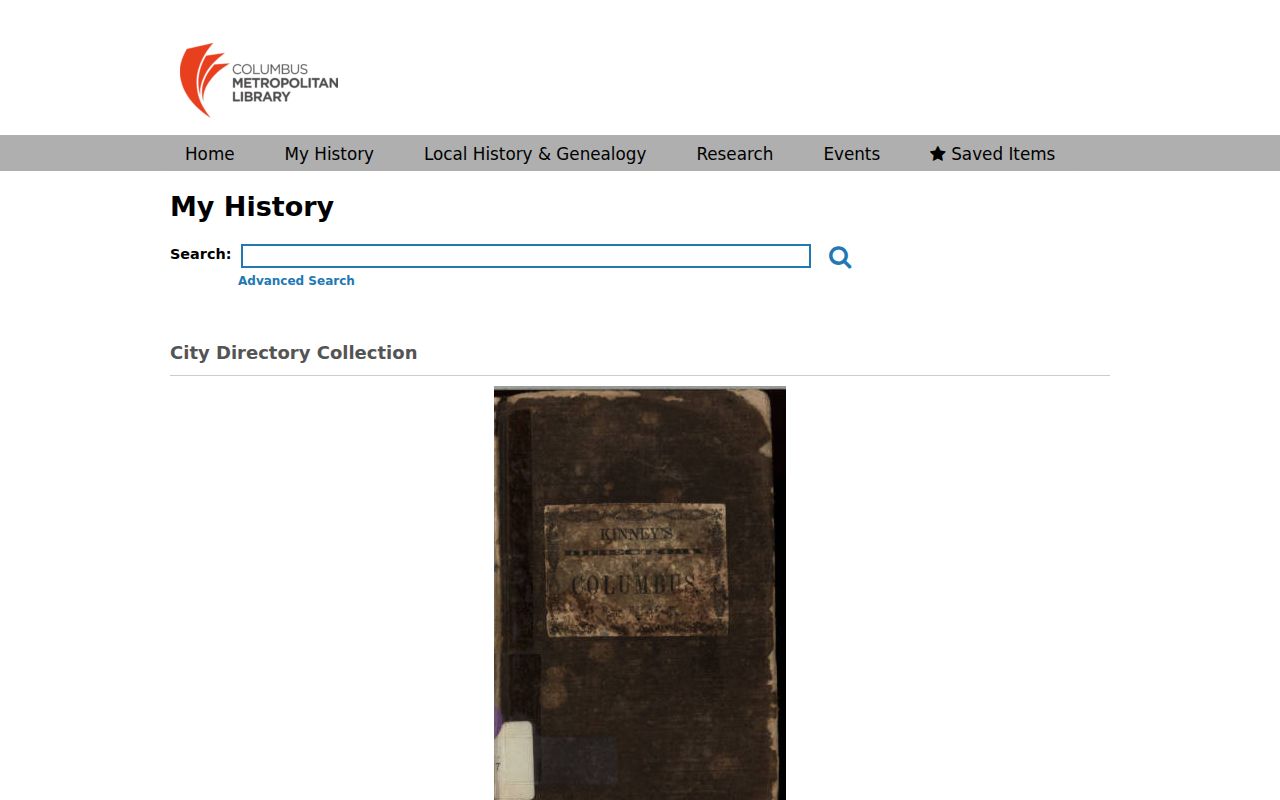
Use the catalog and the book image together. A searchable result can locate a page, while the printed volume supplies the edition context and its own abbreviation key.
Clinton Township Directory Publishers
The directory run changes hands over time. CML identifies 1843-44 Columbus Business Directory, 1845-46 Kinney's, 1852 printed volumes, Williams' volumes for 1856-57 and 1858-59, Lathrop's for 1860-62, then later runs that include 1864, 1866-67, 1873-82, 1884-90, 1902, 1905-06, 1907-08, and 1910-11. Those publisher changes matter because a format, address practice, or index may change with the book. Do not assume that one publisher's marks carry into another's volume.
The 1852 Columbus directory is an early example. Its title names officers, householders, and business persons, which makes it useful for an early name trail but not a modern-style list of every household member.
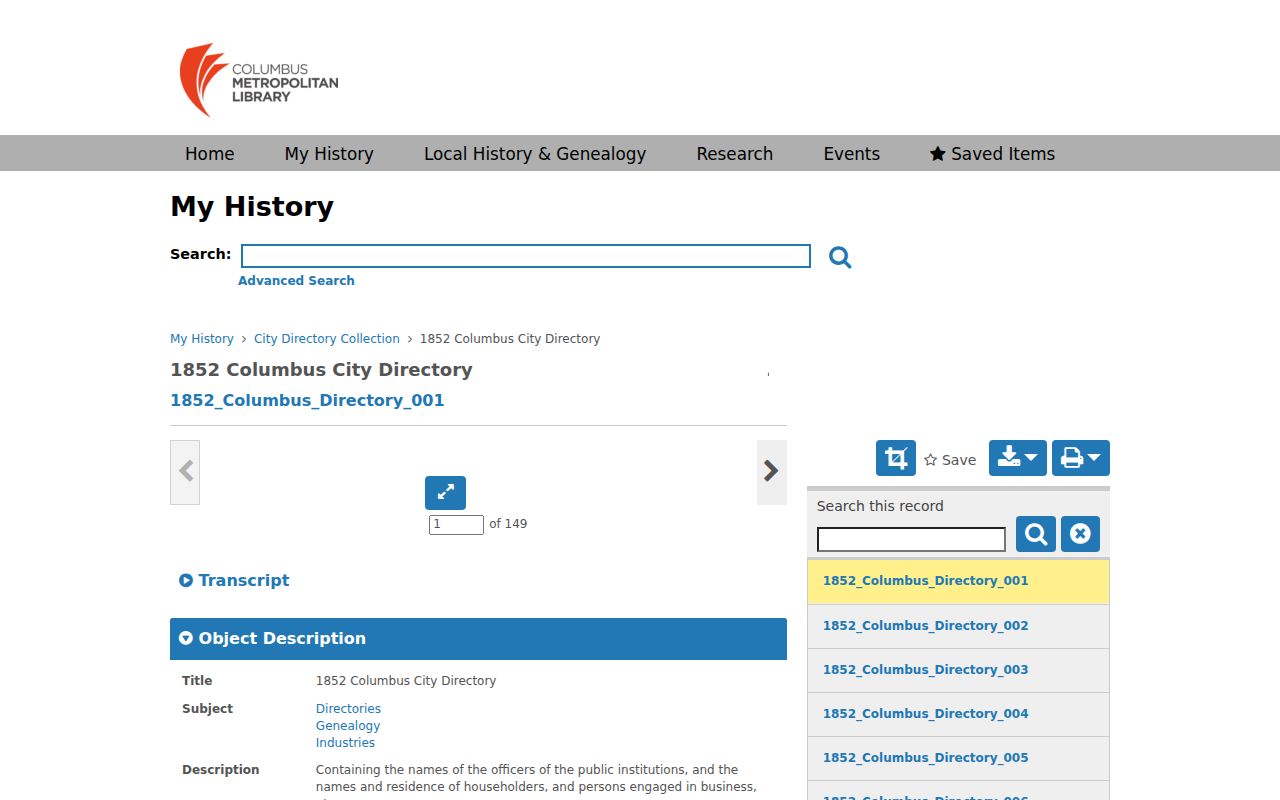
Early printed volumes need patient reading. Record the title, publisher, edition year, and page beside each transcription so another researcher can recheck the same entry.
A later 1889-90 R. L. Polk directory identifies the Polk company in its metadata and mixes alphabetical private-citizen and firm listings with local institutions. That layout can provide a useful transition point when comparing a Clinton Township family through the changing Columbus publishing market.
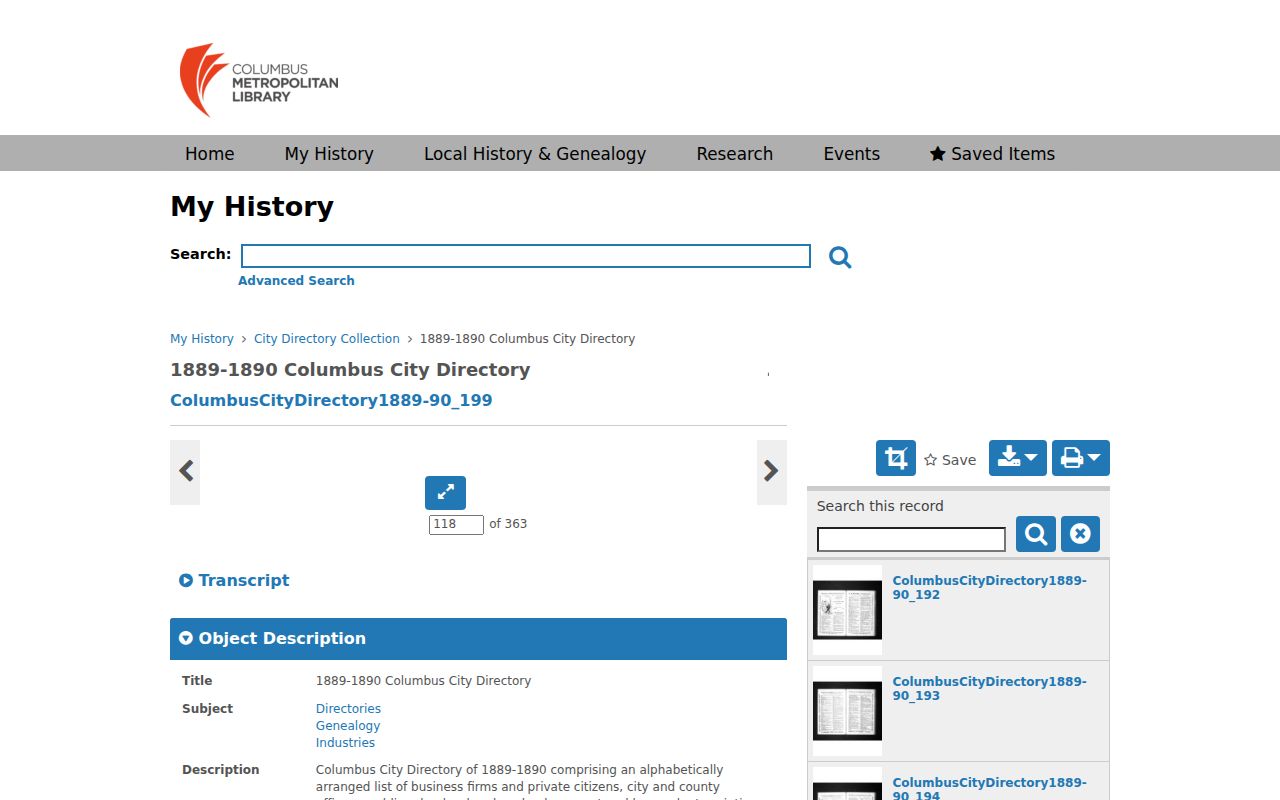
The Polk image is evidence of a particular publication, not a claim that every part of historic Clinton Township was included in that edition.
Reading a Clinton Township Directory Entry
A digitized Columbus directory inspected by CML uses a familiar pattern: surname, given name or initials, an occupation or workplace shorthand when supplied, and an address. The letter h repeatedly marks a home or residence address. Initials and shortened given names are common. Preserve the spelling shown rather than silently changing it to a modern form. Some editions include spouse, widow, or occupation conventions, but the front matter of that exact book is the only safe key.
| Name form | Surname, given name, initials, or a spelling variant as the volume prints it. |
|---|---|
| Residence clue | h can mark a residence or home address in the inspected directory pattern. |
| Work clue | An occupation, employer, or workplace shorthand may appear when the publisher included it. |
| Address | A line ties the listed person to an address for that edition year, not to uninterrupted occupancy. |
| Family signals | Spouse or widow wording may occur, but meanings must be verified in that volume's key. |
- Criss-cross directory
- An address-ordered section that lets a researcher start with a street or house number instead of a surname.
- Householder index
- An index organized around the person listed for a household; it does not necessarily name every person there.
- Abbreviation key
- The explanatory list in a particular volume's front matter. Photograph or note it before interpreting symbols.
For a later current-address check, turn to the Clinton Township resident lookup routes rather than treating the historical line as present-day proof.
Clinton Township After the 1911 House List
CML identifies the 1911 directory as the first in its local route to include a street-address and house-listing section. That is a practical turning point. For a 1911-or-later address, open the street or house section, then compare the alphabetic entry. For earlier books, start from a surname obtained through a deed, tax duplicate, census, obituary, or Probate lead. Dreher's Simplex Guide for 1917-18 and the Street and House Number Guide for 1929-30 provide an additional address-focused path.
Early Franklin County phone books can add a subscriber clue. They do not prove who occupied every unit, and a directory address does not establish ownership. Modern parcel questions belong with the Clinton Township street directory record chain, where property records and historic directories serve different purposes.
Note: Compare an alphabetic listing with the house section when both exist, because one format can expose a variant the other does not.
Tracing a Clinton Township Directory Household
A household trail works best when each volume is treated as a time-stamped observation. First establish whether the address was within the book's Columbus coverage. Then record the name exactly, the residence marker, address, work clue, and edition year. Compare the volume immediately before and after it. A disappearance may reflect a move, death, a changed listing practice, or a boundary issue. It does not settle the question alone.
- Find the earliest likely listing by surname or, after 1911, by the street and house section.
- Copy the entry exactly and note the publisher, year, page, address, initials, and every visible abbreviation.
- Check neighboring editions for moves, spouse or widow wording, and changes in the residence line.
- Pair the entry with the closest released federal census. The 1950 census was the latest released census during this research, and its date is not the directory's compilation date.
- Use Recorder, Probate, obituary, or death material to test a title transfer, estate transition, or reported death.
Maps help with an address that looks unfamiliar. CML points to Caldwell's 1872 atlas, Baist atlases for 1899, 1910, and 1920, a 1910 folio atlas, a 1937 plat book, and Sanborn material. Check each map sheet's extent before saying that it covers a particular Clinton Township address.
Clinton Township Directory Gaps
When a directory year is absent or an address falls outside a volume's reach, use a different dated source instead of forcing a conclusion. CML's house-history research notes that Auditor transfer history and prior history can lead to tax assessment lists from 1920 for many properties. For earlier periods, the Ohio History Connection holds Franklin County tax duplicates for 1806-1810, 1816-1838, 1868, 1902-1907, and 1914-1919. These are selected runs, not an unbroken annual file.
Ohio History Connection Archives & Library is the state archive fallback for tax duplicates and transferred records. Its research room posted Thursday and Friday hours, with limited paging, during this research. Plan the record series and dates before contacting the archive, and verify hours before travel. FamilySearch also catalogs 76 reels of Franklin County deed records for 1804-1877, although image access can vary.
The Franklin County Genealogical & Historical Society publication list adds chancery, will and estate, cemetery, census, plat-map, and other finding aids. Its volunteer capacity was limited for new requests during the remainder of 2026, so a needed directory or map should also be pursued through CML or Ohio History Connection rather than assumed available from a private lookup.
Clinton Township Directory News Checks
A directory trail gains context from CML's News and Obituary Index, which covers local-interest material from 1960-1997 and obituaries from 1931-1997. The News and Obituary Index is a lead, not final proof. Retrieve the underlying notice, then compare it with a death, Probate, or other official record before resolving a same-name question. CML accepts up to six obituary requests per month through its request form and says replies are generally within 48 hours.
The source screen is the library's news and obituary index, a useful stop when a directory entry ends abruptly or an estate question appears.
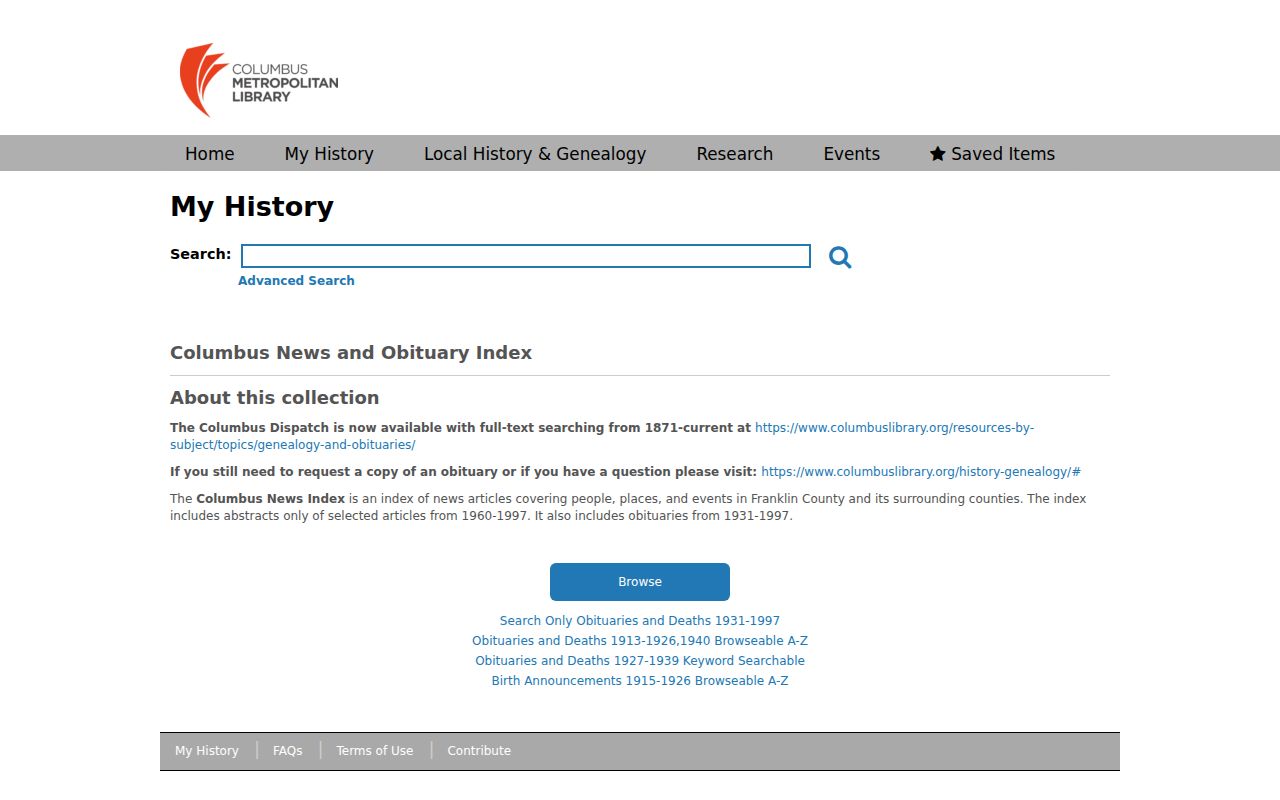
The result points to material worth requesting or reading. It should not be used alone to combine people who share a surname.
CML also reports Dispatch Digital coverage from 1871 forward and historic newspaper microfilm at Main Library. In November 2025, it added 1986-2018 Dispatch image scans. That expanded image access is helpful for names and addresses that do not appear in a digitized volume.
Historic Clinton Township in Columbus Catalogs
Clinton Township was created on July 1, 1811, but its historic area changed sharply after Columbus annexations in the 1950s and 1960s. A historic Clinton Township family may therefore be indexed under Columbus, a postal Columbus address, or an older road name. Cleveland Avenue's earlier Harbor Road name is a useful research variant in maps, plats, newspapers, and directories. It is not evidence that two names identify the same person.
The township history gives the records geography behind that cataloging problem. The directory shelf is often the right source even when the subject used a Columbus label, while the parcel and deed history can identify the actual jurisdiction. Keep the address, date, and source beside every result.
Note: A Columbus catalog heading can be the correct historical route for Clinton Township research because jurisdiction and postal labels changed over time.
Clinton Township Directory Milestones
Two numbers shape the historical search. CML's city-directory shelf begins in 1841, while its first identified street-address and house-listing section arrives in 1911. Before that later turning point, a name, deed, tax, census, obituary, or Probate lead is usually needed to locate a household. After it, an address can often become a more direct entry point. That difference prevents an early blank street search from being mistaken for a negative finding.
The library's research tools route joins the directory shelf with newspapers and other local-history resources. The linked source screen below shows the research gateway used to move from a city-directory clue to a companion source.
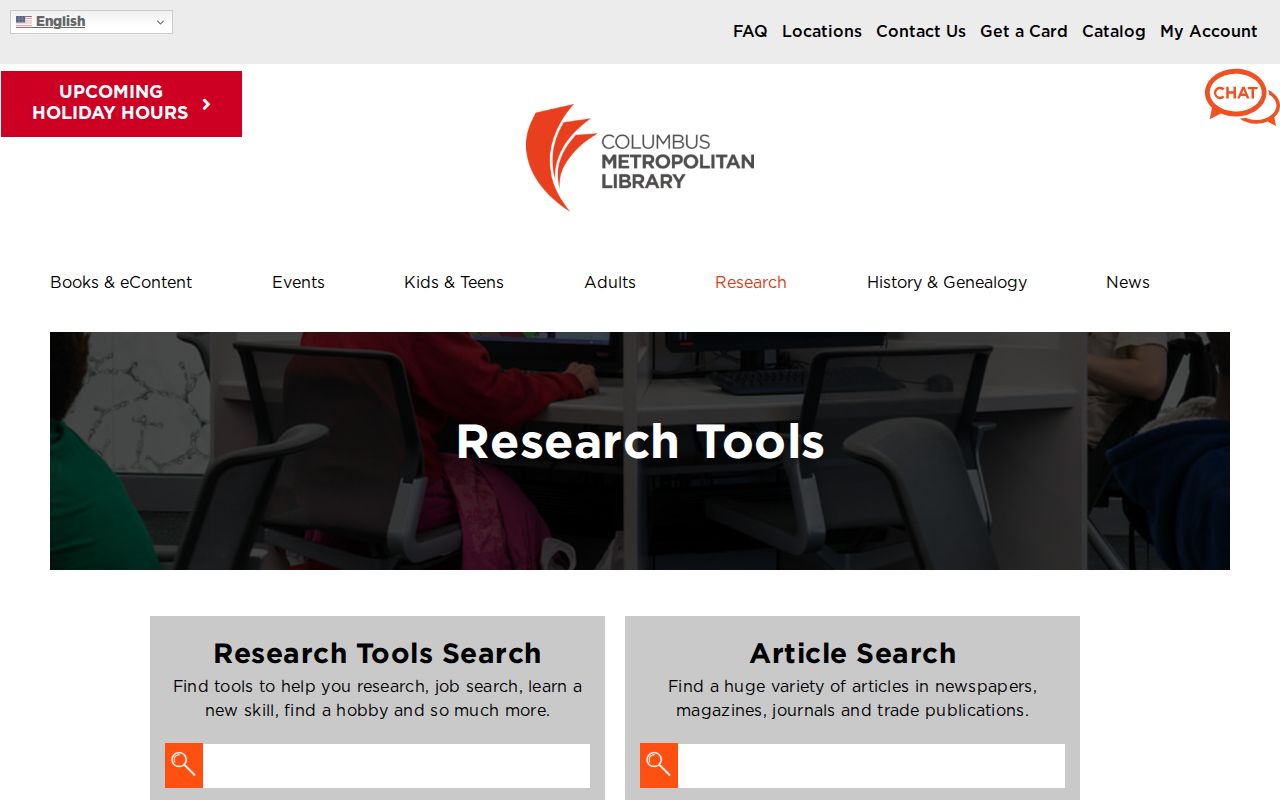
Use the date window to select the right collection first. A carefully chosen book or index is more useful than a broad name search across unrelated sources.