
Past Clinton Township Residents Sources
A backward address trail has two layers. Recorded deeds show a dated property interest and can carry the chain of title from one owner to another. Directories, phone books, census schedules, obituaries, and estate records can add evidence about past residents or households. Start with the source nearest the time in question. A recent transfer points to the Recorder. A household question in an older period often needs the library’s address directories and census pairing. No row below proves that every person at an address was a resident or owner.
| Historical source | Local era | Where to reach it | What it contributes |
|---|---|---|---|
| Recorder legacy deed indexes | 1804–1913 | Legacy system or Recorder counter | Grantor, grantee, and book/page route into a title chain. |
| Recorder deed index | January 2, 1914 forward | Cloud Search, legacy search, or counter | Recorded deed parties, dates, and instrument trail. |
| Tax duplicates | 1806–10, 1816–38, 1868, 1902–07, 1914–19 | Ohio History Connection | Taxpayer and parcel clues during gaps. |
| Columbus city directories | Physical run from 1841; address sections from 1911 | CML Main Library and selected digital volumes | Dated name, address, and occupation clues where the volume covers the area. |
| Federal census | Released schedules through 1950 | National Archives and research repositories | Household snapshot to compare with a nearby directory year. |
| Maps and permit material | Sanborn maps 1887–1951; Columbus permits about 1920 onward where applicable | CML, map collections, or city custodian | Street and building context, not a people list. |
When no online result appears, do not skip to a broad people search. Use the Recorder counter or certified-copy channel for a known document, the library shelf for an unscanned directory year, and Ohio History Connection for tax-duplicate or archival research.
Clinton Township Address Deed Records
The Franklin County Recorder public-records page links to both public Cloud Search and the legacy search. Ordinary Cloud Search use does not require an account, and the legacy route allows guest searching. Search first with the parcel, legal description, current owner, recorded seller, or instrument clue from the Auditor parcel record. The Recorder’s own materials state that a property street address is not an index value, so an address-only attempt can miss the deed completely.
The Recorder Cloud Search is the current official online route for documents. Its guide says the search accepts words in any order; quoted text requests an exact match, an asterisk represents variable characters, and a question mark represents one character. Use a document type or recording-date filter when a party query is broad. Record the document type, parties, recording date, legal or parcel clue, and document placement before moving to the prior transfer.
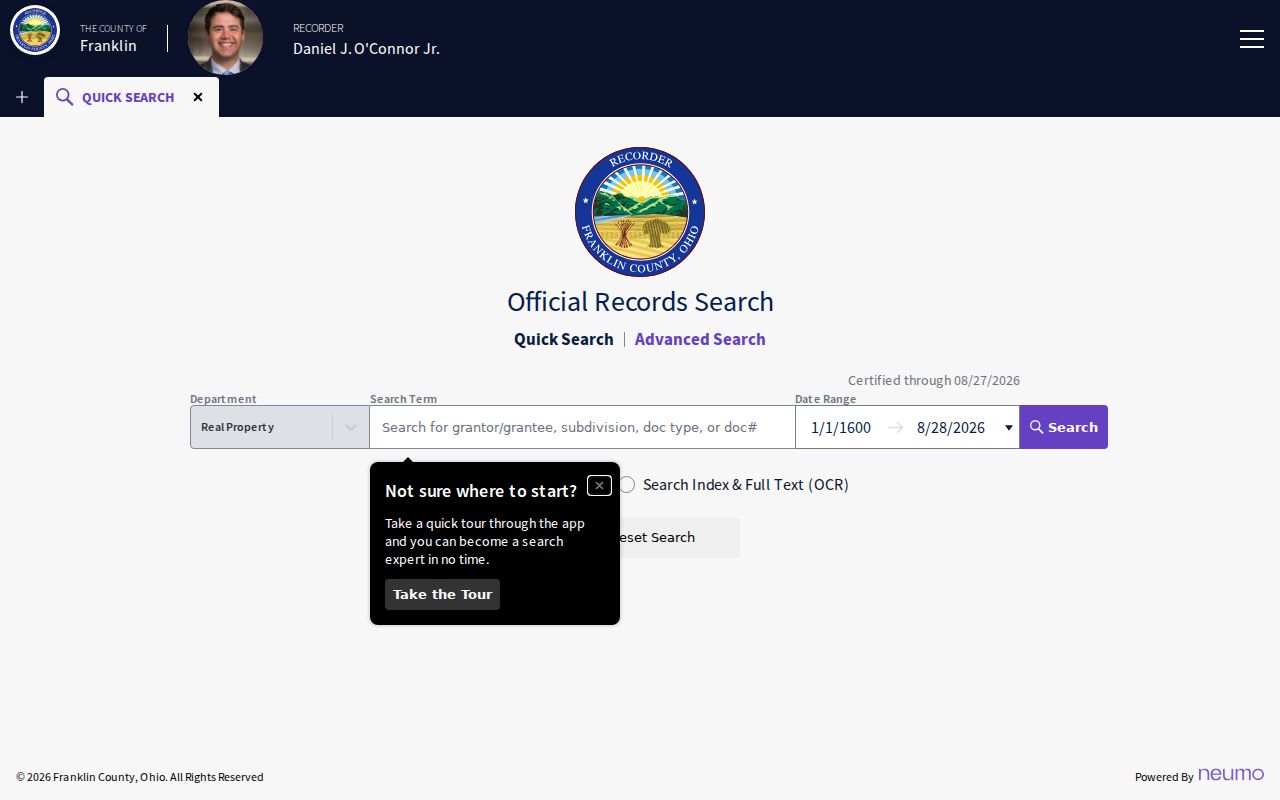
The Cloud Search screen is a document-search starting point. It does not turn a parcel history into a complete list of former household members.
Clinton Township Historic Records Boundary
The change between the 1913 and 1914 deed indexes matters for an old Clinton Township address. The Recorder’s guide directs searchers looking for 1804–1913 deed indexes to the previous or legacy search engine. Its historic route includes an 1804–1888 Grantee Deed Index. For older placement, use the handwritten book and page clues found in the index. Records before October 10, 1980 may use book, volume, and page; material from then through May 14, 1997 may use microfiche volume and page; later instruments use a 15-digit instrument number.
The Recorder search guide illustrates the historical route and the inputs that bridge current work to deed books.
The guide is especially useful when a modern result needs to be converted into the older grantor-grantee and book-page research method.
The Recorder legacy search is the operational fallback for that archive route.
Use the legacy record as an index lead, then verify the deed image, book reference, or counter-held material for the exact parcel connection.
Trace Clinton Township Deed Records
A repeatable title method begins with today’s parcel and walks backward through the actual property relationship. The Auditor card supplies the exact legal description, parcel, situs, current owner, mailing contact, and transfer clue. Find the current owner’s acquisition deed, identify the seller, then search that seller as a grantee with the same legal or subdivision clue to find the earlier acquisition. Repeat the same check for each transfer. This protects against joining two people with the same name or two parcels with a similar street address.
- Search the Auditor Property Search by address or parcel. Preserve the parcel number and legal description, not only the street number.
- Find the present owner’s acquisition record in the Recorder system. Confirm the parcel or legal description in the returned document.
- Identify the prior seller, then search that person as grantee with the same property clue. This locates the prior purchase rather than an unrelated document.
- Continue from grantee to prior grantor, noting each recording date and document reference. Switch to the legacy deed-index route at the 1913/1914 boundary.
- When the property clue changes form, use deed books, microfiche, Recorder staff help with website use, or the Engineer map and plat records to reconcile it.
- Grantor
- The party transferring an interest in a recorded instrument.
- Grantee
- The party receiving that interest. In a backward deed search, a prior seller can become the grantee on an earlier deed.
- Chain of title
- The sequence of recorded property transfers tied to the same parcel or legal description.
- Legal description
- The lot, subdivision, metes-and-bounds, or other property description used in instruments. It survives changes in street numbering better than a mailing address.
Note: A recorded transfer establishes a property interest at a documented point in time, not the complete membership of a household.
Clinton Township Record Story
Franklin County’s long deed trail has a real caution point. County deed books begin in 1803 according to the Columbus Metropolitan Library guide, while Recorder archival indexing begins in 1804. A historic Recorder guide says some older county documents were destroyed in an 1879 fire, though most were reconstructed. An incomplete or difficult entry near that period is a reason to compare the deed index with a reconstituted record, tax duplicate, map, and Probate source, not a reason to invent a missing owner or abandon the parcel trail.
That history is particularly relevant in Clinton Township because early records may describe a much larger historic township area now addressed as Columbus. The document date, legal description, and historical road terms establish the connection more reliably than a modern postal label.
Clinton Township Historic Address Changes
Street continuity can break a good deed search. Clinton Township was created in 1811 and later annexations fragmented its territory. A historical record can therefore be cataloged under Columbus, a former township description, or an older road name. The Township history identifies Cleveland Avenue as Harbor Road in an early account. Check both road names, compare plats and maps, and ask the Franklin County Engineer’s Tax Map Office for old-road, annexation, survey, or legal-description context when a number or street seems to disappear.
Do not assume a built-year field resolves the issue. CML’s house-history guidance warns that property built-year data before 1920 may be a guess. A date becomes stronger when it agrees with a permit, map sheet, transfer, tax duplicate, and dated directory entry.
Clinton Township Past Residents Households
Deeds tell only part of a house history. To learn who lived there before, pair address-oriented directories with the nearest released census year and then look for newspaper, obituary, or Probate evidence. Columbus Metropolitan Library’s physical city-directory shelf begins in 1841, while address listings begin in 1911. Selected digitized volumes and early Franklin County phone books can be searched online, but a missing digital year calls for the Local History & Genealogy shelf rather than a conclusion that the household was absent. The broader collection detail belongs on the Clinton Township city directory page.
- Choose the directory year closest to the transfer, residence, or construction date you are testing.
- Find the address listing or name entry, and save the spelling, address, occupation, and any householder notation exactly as printed.
- Compare it with the nearest released census schedule. Treat both as dated snapshots and resolve spelling or street-name differences before combining them.
- Use a local obituary index, newspaper notice, or Probate estate only to document a specific later event and connection.
The Columbus Metropolitan Library house-history guide brings together directories, maps, Auditor history, county deeds, permits, newspapers, and obituaries for this kind of address research.
The library route complements official title records by helping a researcher match an address to a dated household, map, or newspaper source.
Clinton Township Map Records
Maps and tax material fill the spaces between title transfers and directory snapshots. Ohio History Connection holds Franklin County tax-duplicate islands for 1806–10, 1816–38, 1868, 1902–07, and 1914–19. CML identifies Sanborn and Columbus historic-map coverage for 1887, 1891, 1901, 1921, and 1921–51. Check whether a sheet reaches the specific address before relying on it. A map can show building or street layout, while a tax duplicate can provide a taxpayer and parcel clue. Neither substitutes for a deed or an enumeration record.
Ohio History Connection’s Archives & Library is the archival fallback, with its current research access and limited paging schedule published on its site. CML, the Recorder, and the Engineer each retain different parts of the address trail.
Clinton Township Copy Records
A document found online is often only an index lead. The Recorder states that unofficial copies can be printed free from its public search. Its certified-copy route accepts online, mail, and in-person requests. The stated certified-copy price is $2.00 per page plus a $1.00 certification fee per document, with postage where applicable. Give the office the instrument number or book, volume, and page if available, together with the property clue and document type. This is more reliable than asking staff to identify a full title history.
The Recorder certified-copy request page describes the official request channels.
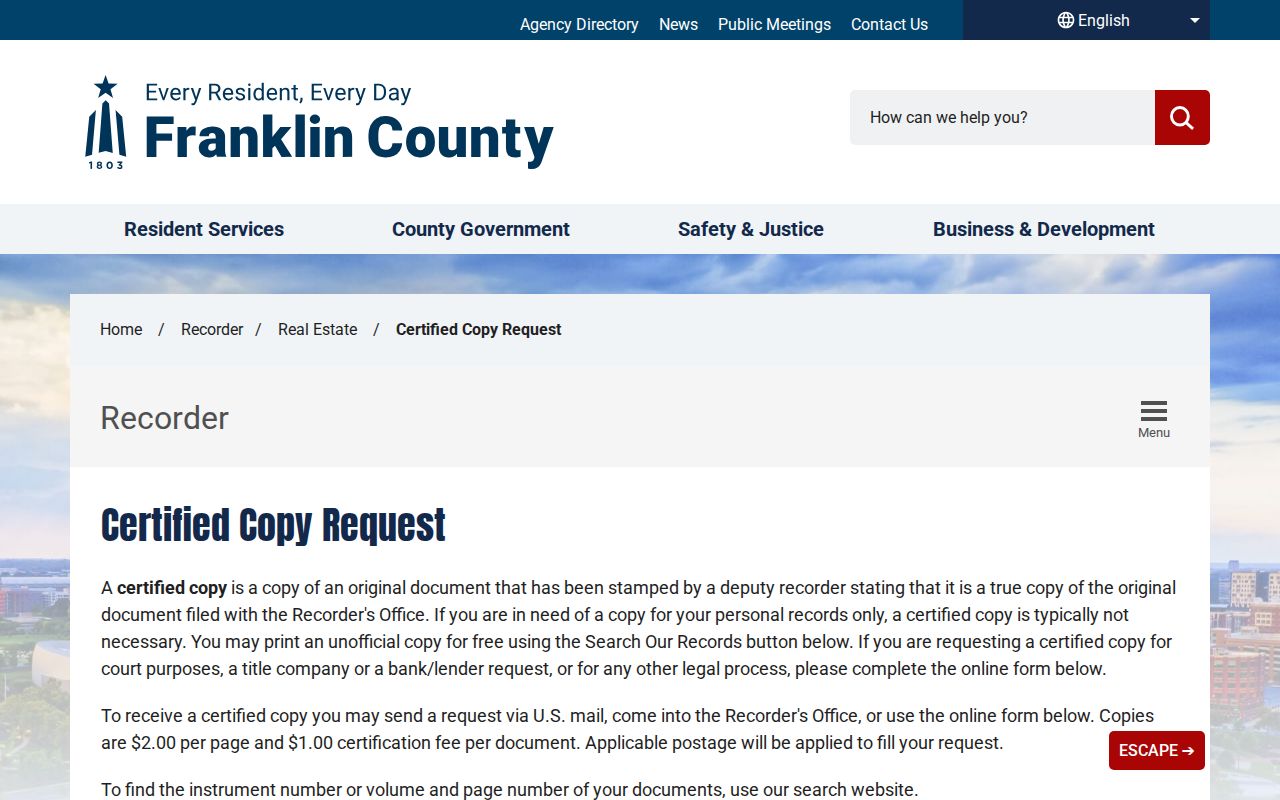
For records outside the online index, the Recorder counter at 373 S. High Street, mail, and the posted request route provide document-specific alternatives.
Note: Ask for one defined record or time range. The Recorder can assist with its website but does not perform an extensive title search.
Clinton Township Address Record Limits
Previous-residents research is strongest when it stays with the address history. A deed party may have held title without living on the property. A directory or phone-book entry can be a subscriber or a short-term household clue. Census and obituary material document particular dates. Adoption, mental-health, developmental-disability, protected-address, motor-vehicle, and confidential court material do not become searchable because an old address is known. An absent entry can reflect coverage, confidentiality, a changed road name, or an address outside a source’s geographic scope.
Lawful use. Clinton Township previous-residents research is for house history, family history, estate matters, and personal curiosity. Do not use address records to track, harass, intimidate, or harm a living person.
For a defined public record that is not online, request it from the custodian under the Ohio Public Records Act, R.C. 149.43, with the record type, property clue, and time period. The county office, library, archive, or records custodian can then apply its actual access and confidentiality rules.